Showing posts with label Colombia. Show all posts

Friday, May 6, 2011

En el fin, ¿cúales la importancia y las resultados?

In the end, what can be gathered from this survey? Have we been able to understand the usage of magical realism and it's purpose?

We've gathered that magical realism serves as a way to create a nearly believable environment in which the reader can relate to the fictitious characters while still being reasonably removed from the environment.

In addition, by using magic realism in the character's life and death, the author is able to create an echo or reflection of the character's life. Often meaningful, and always personal, it serves to put an emphasis on the important aspects of the character and to make a statement about what is important to the individual. In the aspect of death, García Márquez establishes his unique writing style in defining the death of the character.

However, could it be said that the most useful aspect of the motif is to add social commentary? By combining imaginative writing with social and political commentary in a novel, García Márquez is providing his native Colombia with not only a novel of respectable quality but with an iconographic work of literature of which they can be proud.

Perhaps the best way to discern the true potential and goal for not the only usage of magical realism and yet the novel itself is not to study multitudes of journals and books, but to look to the author himself. In reading or listening to his Nobel Prize acceptance speech in 1982, it's not too difficult to read between the lines and understand what it is he had hoped to accomplish through his prized novel and lifetime of work.
"Latin America neither wants, nor has any reason, to be a pawn without a will of its own; nor is it merely wishful thinking that its quest for independence and originality should become a Western aspiration. ... No: the immeasurable violence and pain of our history are the result of age-old inequities and untold bitterness, and not a conspiracy plotted three thousand leagues from our home. But many European leaders and thinkers have thought so, with the childishness of old-timers who have forgotten the fruitful excesses of their youth as if it were impossible to find another destiny than to live at the mercy of the two great masters of the world. This, my friends, is the very scale of our solitude." (Ortega 90, emphasis my own)
Later on in the speech, García Márquez continues with the idea of Latin America's own solitude.
"Faced with this awesome reality that must have seemed a more utopia through all of human time, we, the inventors of tales, who will believe anything, feel entitled to believe that it is not yet too late to engage in the creation of the opposite utopia. A new and sweeping utopia of life, where no one will be able to decide for others how they die, where love will prove true and happiness be possible, and where the races condemned to one hundred years of solitude will have, at last and forever, a second opportunity on earth." (Ortega 91, emphasis my own)

A closing thought perhaps,
"The repeated follies of José Arcadio—like the name and hereditary stubbornness of his great-grandson, like Ursula's pronouncements, like the end of the novel—are attempts on the part of García Márquez to assert that history is, in some sense, circular. The "primitive" past of Latin America, like that of Macondo, might have provided countless omens of Colombia's future, if anyone would have paid attention—that is, if anyone would have avoided the delirium of progress." (Conniff 177) 
For academic purposes, I have attached a Works Cited page.

Wednesday, April 20, 2011

Todo sobre mi amigo Gabo


Before delving into an analysis and survey of an author's work, I think it is important to understand their biography and have a background knowledge of them. For example, we can listen to Beethoven's Ninth Symphony and enjoy how awesome it is, but when we know that he composed it after going completely deaf, doesn't that make the listening experience so much richer?

  • Gabriel Garcia Márquez was born in Aracataca, in the province of La Guajira, a small town in northern Colombia in 1928. The town is situated in a tropical region between mountains and the Caribbean Sea. The surface area of Colombia is twice the size of Texas and has a population of about 30,000,000. Like many South American countries, Colombia enjoys a variety of landscapes.
"Its geographic spread includes the sparsely settled eastern plains, the high chill of the Andean chain and Bogotá, the coastal heat of the Caribbean provinces, the desert desolation of the Guajira peninsula jutting to the northeast, the lush "eternal spring" of the western Cordillera Central and the Cauca Valley with its cities Medellín and Cali, and the vast, humid Amazon bush dipping four degrees south beyond the equator. Colombia is the one mainland South American country blessed with both Atlantic and Pacific littorals; it shares borders with Venezuela, Ecuador, Peru, and Brazil; and through Panama(formerly Colombian territory) it has a Central American frontier." (Bell-Villada 15)
With such a beautiful landscape to stimulate imagination, it is easy to see how García
Márquez was able to come up with a place as spectacular as the fictitious Macondo.


  • His father was a telegraphist and he was not approved of by his wife's family since he was an outsider. Because of the family's disapproval, the couple moved away but García Márquez's mother returned to her home town to give birth to their first child, Gabriel. She ended up leaving him with her parents in order to return to her husband. He was raised by his maternal grandparents and his grandfather,Nicolás Márquez Iguarán, was a colonel in the civil war during the start of the century. He stayed there until his grandfather died when the boy was only eight years old. García Márquez has been quoted in many interviews throughout his life that "nothing interesting has happened to me since then".

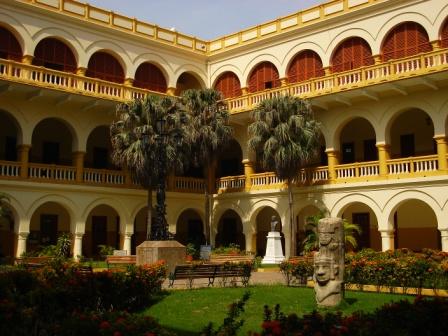
  • He originally attended a Jesuit college, University of Cartagena,(above photo) to pursue studies in law but became involved in journalism. During the late 1940's, he wrote for El Universal in Cartagena. In 1954, he was sent to Rome for an assignment and that spurred on travel and living abroad in his life. He began to publish literary work in 1955 with his first book, La hojarasca( the leaf storm). Along with writing fiction, he continued to work as a journalist and to write screenplays.
  • In June of 1967, Editorial Sudamerica published Cien Años de Soledad. The initial printing was only 8,000 copies and now has been translated into over 35 languages and has sold 30,000,000 copies worldwide.
In this video, García Márquez talks about the writing of One Hundred Years of Solitude  and why he likes the novel. Unfortunately, it's not in English...but I enjoyed it.

García Márquez is often heralded as the premiere Colombian writer and for plenty of good reasons. The Colombian people love him, his work, and what he represents for them. In his home country, he's nicknamed "Gabo" as a term of endearment. When his Nobel Prize was announced in 1982, people were excited to be able to call him their own.